
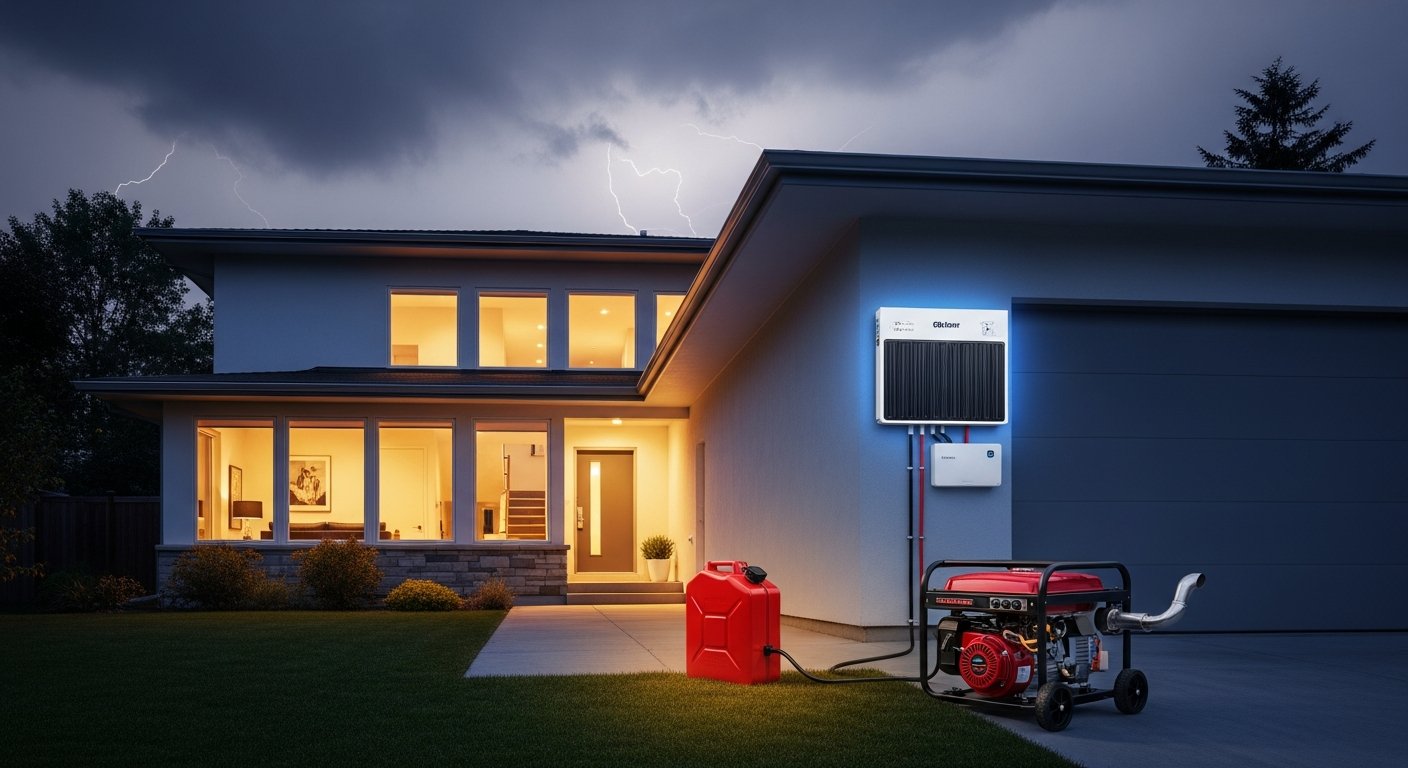
Home Battery Backup vs Generator: Which Is Best?
Compare solar battery backup vs. generator for home power outages. See costs, benefits, and how to choose the right system for your needs.

By Benjamin Taylor
Learn more about Solar Panel Installation and Repair for guides, costs, and what to expect.
Compare Solar Panel Installation and Repair Pros Near You

Enter your ZIP code to compare top-rated local professionals and request free quotes.
When the power goes out, the clock starts ticking. Your fridge begins to warm, the internet router goes dark, and if you rely on medical devices or work from home, the stakes feel even higher. For many homeowners, the question is no longer if an outage will happen, but when. The real decision is how to prepare for it. Choosing between a whole-home generator, a portable generator, and a solar battery backup for home use can feel overwhelming, especially with so many options on the market. But understanding the key differences can save you thousands of dollars and a lot of stress when the lights flicker.
This guide breaks down the practical realities of each backup power option, from upfront costs to long-term value. We will explore how solar batteries have changed the game, why they pair so well with existing solar panel systems, and how to decide which solution fits your home, your budget, and your peace of mind.
Why Home Backup Power Matters More Than Ever
Extreme weather events, aging grid infrastructure, and increasing electricity demand have made power outages more frequent and longer-lasting. A 2023 report from the U.S. Energy Information Administration found that the average U.S. electricity customer experienced over seven hours of power interruptions in 2021, a figure that has been trending upward. For homeowners, these outages can mean spoiled food, damaged electronics, and uncomfortable temperatures, not to mention the potential safety risks for those who depend on electric medical equipment.
Having a reliable backup power for home use is no longer a luxury; it is a practical investment in your family's comfort and safety. But the traditional solution, a gasoline-powered generator, comes with hidden costs and hassles: fuel storage, maintenance, and noise. Solar battery systems, on the other hand, offer a cleaner, quieter, and increasingly affordable alternative. They also provide daily benefits by storing excess solar energy for use at night or during peak rate times, effectively turning your backup system into a money-saving asset.
Understanding Your Backup Power Options
Before diving into the specifics, it helps to see the landscape of what is available. Each option has its strengths and weaknesses, and the right choice depends on your priorities: do you want to power the whole house or just the essentials? Is noise a concern? Are you looking for a solution that also lowers your monthly electric bill?
Here is a quick overview of the three main categories:
- Portable generators: These run on gasoline or propane, are relatively inexpensive upfront, and can power a few circuits or appliances. They require manual setup during an outage, venting to avoid carbon monoxide poisoning, and a steady fuel supply.
- Whole-home standby generators: Permanently installed and connected to your home's electrical panel, these run on natural gas or propane. They turn on automatically during an outage and can power your entire house, but they have a higher upfront cost and require professional installation and regular maintenance.
- Solar battery backup: These systems store electricity from your solar panels or from the grid (if you have a battery without solar) and release it during an outage. They are silent, emission-free, and can be scaled to power just the essentials or, with a larger battery and inverter, your whole home for a limited time.
Each technology has evolved significantly in recent years. Portable generators have become more efficient, standby generators have become smarter with remote monitoring, and solar batteries have dropped in price while increasing in capacity. The best backup power for home use is the one that aligns with your specific needs, your home's characteristics, and your long-term financial goals.
Solar Battery Backup: The Modern Solution
Solar batteries have emerged as a compelling choice for homeowners, especially those who already have solar panels. A solar battery system, like the Tesla Powerwall or the LG Chem RESU, captures excess electricity your panels generate during the day and stores it for later. When the grid goes down, the battery automatically disconnects from the grid and powers your home's critical loads, such as lights, a refrigerator, and your internet router.
The primary advantage of a solar battery is that it produces no emissions and operates silently, which is a huge plus for residential neighborhoods. You do not need to worry about fuel spoilage or running to the gas station during an emergency. Moreover, the battery can be programmed to charge during off-peak hours when electricity is cheapest, then discharge during peak hours when utility rates are highest, saving you money on every bill, not just during outages.
From a financial perspective, solar batteries have a longer lifespan than generators (typically 10 to 15 years) and require minimal maintenance. They also increase your home's energy independence, which is a growing selling point for eco-conscious buyers. If you are considering solar panels, adding a battery can enhance your system's overall return on investment. For a detailed look at how solar panels and batteries affect your home's value and payback period, review our solar system investment analysis for homeowners.
How a Solar Battery Works During an Outage
When the grid fails, a solar battery system with islanding capability automatically detects the outage and disconnects from the utility. This safety feature, required by law, ensures that your system does not send electricity back to the grid, which could endanger utility workers. Once isolated, your home runs entirely on the battery's stored energy. The length of time you can run on battery power depends on the battery's capacity (measured in kilowatt-hours, or kWh) and the loads you are drawing. A typical 10 kWh battery can power a refrigerator, lights, and a laptop for 10 to 12 hours, but if you also need to run a well pump or an air conditioner, that time drops significantly.
Some advanced systems allow you to prioritize certain circuits, ensuring that your essential loads are powered for as long as possible. You can also pair the battery with a solar inverter that allows you to use solar energy during the day, even while the grid is down, thereby extending your backup duration indefinitely if the sun is shining. This is a crucial difference from a generator, which will run out of fuel eventually.
Comparing Costs: Upfront and Long-Term
Cost is often the deciding factor for homeowners. The upfront price varies widely by technology.
A portable generator can cost anywhere from $500 to $2,000, depending on wattage and brand. A whole-home standby generator, including installation, typically runs from $5,000 to $15,000. A solar battery system, installed, generally costs between $10,000 and $20,000, but this figure can be offset by federal tax credits and, in some states, additional incentives. For example, the federal Investment Tax Credit (ITC) currently offers a 30% credit for battery installations, which can shave thousands off the initial price.
However, the long-term costs are where the scenarios diverge. Generators require fuel. A whole-home generator can consume 2 to 3 gallons of natural gas per hour, which adds up during a multi-day outage. You also need to schedule regular maintenance, like oil changes and battery checks, costing roughly $200 to $400 per year. Portable generators have similar fuel and maintenance costs, plus you need to store gasoline, which degrades over time.
Solar batteries, in contrast, have no fuel costs and minimal maintenance. The only recurring cost is the electricity you use to charge them (which is often free if you have solar panels). When you factor in the potential savings from time-of-use arbitrage, a battery can actually pay for itself over its lifetime. To better understand the financial picture, our guide on solar cost breakdown for homeowners in 2026 breaks down the average system costs, incentives, and payback periods in detail.
Generator vs. Solar Battery: Which Should You Choose?
The answer depends on your specific circumstances. If you live in an area with frequent, short outages, and you want to power your entire home including central air conditioning, a standby generator might be your best bet. It provides unlimited runtime as long as fuel is available and does not require you to change your energy habits.
If you are looking for a backup power for home that is quiet, clean, and also helps you save on daily electricity bills, a solar battery is the smarter investment. It is particularly advantageous if you already have solar panels, as the battery can store the energy you generate, giving you true energy independence. Additionally, if your utility has demand charges or time-of-use rates, a battery can help you avoid those high costs, accelerating your payback.
For many homeowners, a hybrid approach works best: a solar battery to cover the essentials and reduce daily costs, plus a small portable generator for extended outages or high-power needs. This combination provides resilience without breaking the bank.
It is also worth noting that solar batteries are a key component of a home solar system's long-term value. They allow you to maximize your solar energy usage, which is especially important if your utility's net metering policy is not favorable. To delve deeper into how solar panels and batteries together affect your long-term savings, check our analysis on why solar savings estimates change.
Key Features to Compare Before You Buy
When evaluating specific products, keep these technical specs and features in mind:
- Power output (kW): This is the maximum amount of power the system can deliver at once. For a battery, this is the inverter's rating; for a generator, it is the generator's wattage. Ensure it is enough to start and run your essential appliances (motors like HVAC compressors have a high starting surge).
- Energy capacity (kWh): Only for batteries. This is the total amount of electricity stored. A higher capacity means longer runtime, but also a higher cost.
- Fuel type: For generators, consider natural gas (unlimited supply but may be interrupted during earthquakes), propane (stored in tanks, requires refilling), or gasoline (convenient but volatile and degrades).
- Transfer switch: This is the device that disconnects your home from the grid and connects to the backup source. For batteries, it is often a smart switch that also manages energy flow for time-of-use optimization.
- Noise level: Generators are loud (60-70 dB), while batteries are silent. This can be a dealbreaker in neighborhoods with strict noise ordinances.
- Maintenance: Generators need periodic oil changes, battery checks, and load testing. Batteries are nearly maintenance-free.
- Warranty: Look for at least a 10-year warranty on batteries, and a 5-year warranty on generators.
Once you have a clear picture of your needs and the specs of each option, you can make an informed decision. It is always wise to consult with a licensed electrician to assess your home's electrical panel and load requirements.
Installation Considerations and Safety
Proper installation is non-negotiable for safety and performance. Whole-home generators and solar batteries must be installed by certified professionals. For a solar battery, this involves mounting the unit on a wall or the floor, connecting it to your electrical panel, and configuring the inverter and control software. The installation can take one to two days, depending on the complexity. You will also need to obtain the necessary permits and pass inspections.
For a standby generator, the process includes pouring a concrete pad, running gas and electrical lines, and installing an automatic transfer switch. This is a more involved process that may require coordination with your utility and local gas company. Always ensure your installer is licensed and insured, and ask about their experience with your specific brand.
Safety is paramount when using any backup power source. Generators must be placed outdoors, away from windows, to prevent carbon monoxide poisoning. Never run a generator inside a garage or near a door. Batteries, on the other hand, are sealed and safe for indoor installation, but they should be installed in a location that is accessible for service and not in a living area.
Making the Most of Your Investment
Whichever system you choose, there are steps you can take to maximize its value. For solar batteries, integrate them with your solar panel system to ensure they are charged by renewable energy, not just the grid. This reduces your carbon footprint and your reliance on fossil fuels. Also, learn to use the battery's app to monitor your energy usage and adjust settings for maximum savings.
For generators, establish a maintenance schedule. Run the generator monthly for 15 minutes under load to keep the engine lubricated and the battery charged. Store fuel properly with a stabilizer, and keep spare filters and oil on hand. In both cases, consider a smart electrical panel that can automatically shed non-essential loads during an outage, extending your backup duration.
Finally, think about the future. As battery technology improves and prices continue to fall, the economics of solar batteries will become even more attractive. If you are on the fence, starting with a solar panel system and adding a battery later is a viable path. Many homeowners choose to install a battery at the same time as their solar panels to take advantage of the tax credit and avoid a second installation cost.
In the end, the best backup power for home is the one that gives you peace of mind and aligns with your financial and environmental values. Whether you opt for the raw power of a generator or the quiet efficiency of a solar battery, you are taking a proactive step toward protecting your home and family. With careful planning and the right partner, you can weather any storm.